01
What is a Level 2 EV charger, and do you need one?
A Level 2 charger runs on a 240-volt circuit — the same kind your electric dryer or oven uses — and adds roughly 20–40 miles of range per hour. That is 5–10x faster than the Level 1 cord that plugs into a standard wall outlet.
For most North County drivers, Level 1 is too slow to fully recharge overnight, especially with longer commutes from Carlsbad, San Marcos, or Escondido. A Level 2 charger lets you wake up to a full battery every morning. It is the right choice for nearly every homeowner with an EV.
02
How much does installation cost in San Diego?
Most home Level 2 installations land between $800 and $3,000 all-in — that includes the labor, wiring, conduit, breaker, and permit. The single biggest variable is how far the charger sits from your electrical panel, and whether your panel has room for the new circuit.
| Scenario | Typical range |
|---|---|
| Charger near the panel, panel has capacity | $800 – $1,500 |
| Longer wiring run / outdoor / detached garage | $1,500 – $3,000 |
| Panel upgrade required first | Add $4,000 – $6,000 |
These are typical ranges, not a quote. The only way to know your number is a quick look at your panel and charger location — which we do for free.
03
Will your electrical panel handle it?
This is the question that determines your real cost. A Level 2 charger needs a dedicated 40–60 amp circuit. If your panel is already near capacity — common in homes built before the 1990s with 100-amp service — there may not be room to add it safely.
We assess your panel's available capacity (and check for a sub-panel option or load management device that can sometimes avoid a full upgrade). If an upgrade is genuinely needed, we tell you up front rather than discovering it mid-job.
04
Permits and SDG&E
An EV charger installation requires an electrical permit and inspection in San Diego County and its cities. This protects you — it confirms the work meets the National Electrical Code and keeps your homeowner's insurance valid.
MIZO pulls the permit, schedules the inspection, and handles any SDG&E coordination if a service upgrade is involved. You do not chase paperwork.
05
How long does it take?
A straightforward install — charger near a panel with capacity — is usually done in a few hours. Add a longer wiring run and it may take most of a day. If a panel upgrade is required first, that becomes a separate step with its own SDG&E and permit timeline.
06
Rebates and tax credits
Incentives change often. The federal 30C credit does not apply to charging equipment placed in service after June 30, 2026. SDG&E still publishes EV rate plans and may offer limited programs, so verify current eligibility before relying on a savings figure.
We cover what is actually available — and the fine print — in our dedicated rebates guide. Always confirm current eligibility with the official source and your tax professional.
Official sources
Common questions
Before you decide.
Can I install a Level 2 charger myself?+
A 240V circuit is high-current work that requires a permit and inspection in San Diego. DIY installation can void your insurance and create a fire risk. It should be done by a licensed electrician.
Do I need a special charger, or just an outlet?+
You have two options: a hardwired charger, or a 240V NEMA 14-50 outlet you plug a portable charger into. Hardwiring is cleaner and supports higher amperage; an outlet offers flexibility. We help you pick based on your car and garage.
How far can the charger be from my panel?+
There is no hard limit, but longer runs add wire, conduit, and labor cost. A charger across the garage from the panel is routine; one in a detached structure costs more.
Which brands do you install?+
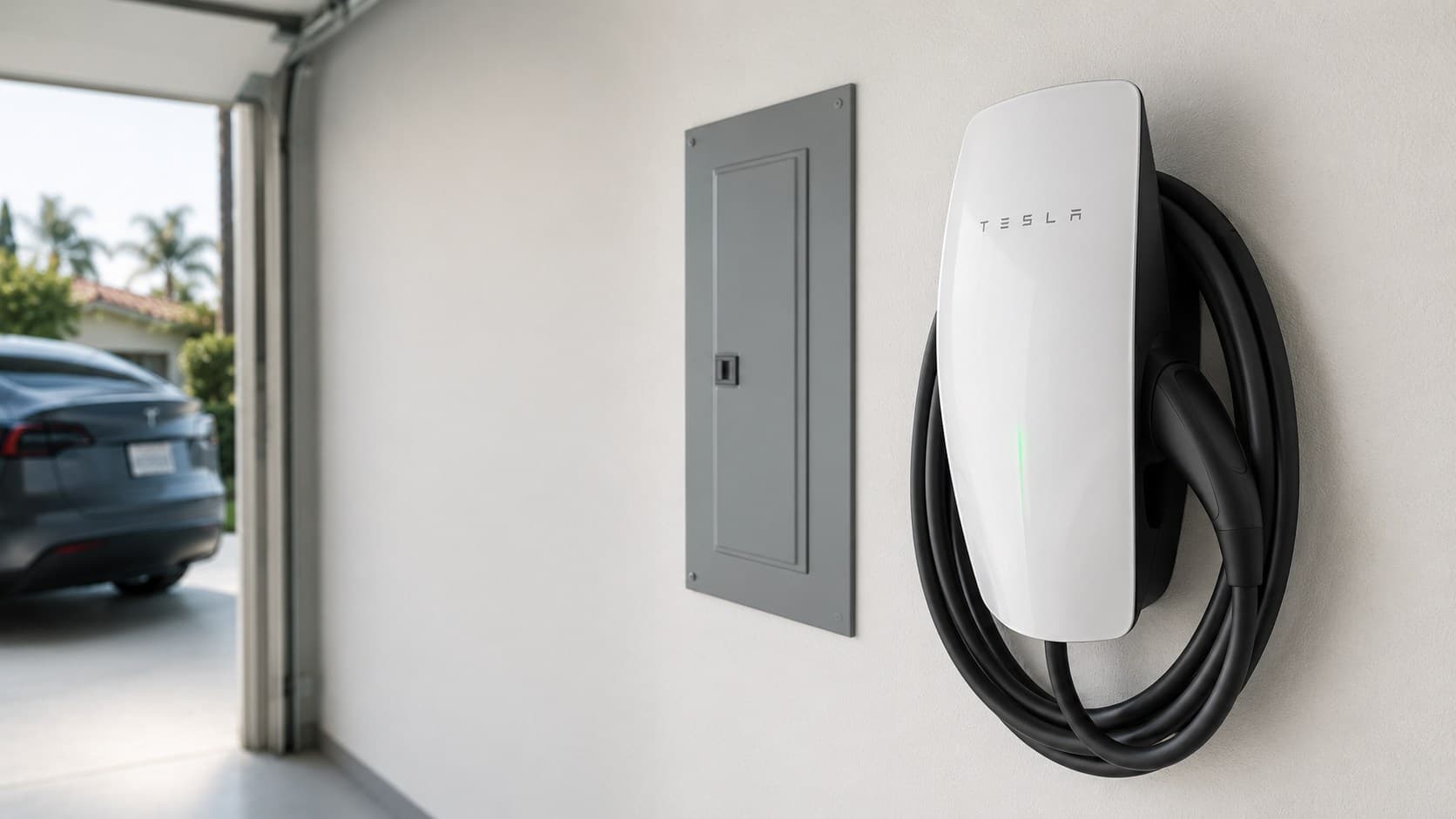
All major brands — Tesla Wall Connector, ChargePoint, Emporia, Wallbox, and more — plus simple 240V outlets for portable chargers.